Key Takeaways
- What the bull flag pattern looks like with a strong flagpole and a shallow flag
- Why the pattern forms when buyers pause after a sharp move up
- How to spot a good flag that stays shallow and short
- Why you wait for a candle close above the flag for confirmation
- How traders use the measured move for targets and place stops below the flag low
Bull Flag Pattern Explained: Spot the Pause Before the Next Leg Up
Ever watched price rip higher, stall for a bit, and then rip higher again while you were still waiting for a dip? That pause in the middle often has a name. Traders call it a bull flag, and it's one of the cleanest continuation patterns you'll find on a chart.
In this guide we'll cover how to spot the flagpole and the flag, what a real breakout looks like, and how some traders plan the entry, stop and target. One thing up front: a bull flag suggests the trend may keep going. It doesn't promise that it will.
What a bull flag is
A bull flag shows up inside an uptrend, and it has two parts:
- The flagpole: a strong, fast move up.
- The flag: a short, tidy pause where price drifts sideways or slightly lower.
Put them together and it looks like a flag on a pole, which makes it one of the few chart patterns that actually looks like its name.
The idea behind it is simple. Buyers pushed hard, some of them take profits, and price catches its breath before the next leg.
The flagpole
No good pole, no flag. You want:
- a sharp move up made of several strong green candles
- big bodies and small wicks
- a move that clearly stands out from what came before
A slow, choppy climb doesn't really count. The pole shows real buying pressure, and later on its height helps some traders set a target.
The flag
After the pole, price pulls back in a small, orderly channel.
- You can usually draw two roughly parallel lines, one across the highs and one across the lows.
- They often slope gently down, against the trend.
- The candles get smaller, and volume tends to dry up, which tells you sellers aren't really pushing.
Two things to watch:
- Stay shallow. Many traders get suspicious when the pullback gives back more than about half of the pole. At that point it looks less like a pause and more like buyers losing control.
- Stay short. A good flag is a handful of candles, not a long sideways mess.
When the pattern is confirmed
The bull flag is confirmed when a candle closes above the upper line of the flag. A wick poking above the line isn't enough, so wait for the close.
Many traders also like to see volume pick back up on the breakout, because it shows buyers stepping back in.
There are two common ways in:
- Buy the breakout close itself.
- Wait for a small retest of the upper line before getting in.
Both can work, as long as you pick one and stick to it.
Planning a trade
A common plan looks like this:
- Entry: on the close above the flag.
- Stop: just below the lowest point of the flag. If price falls back through there, the idea is broken.
- Target: the measured move. Take the height of the flagpole and add it to the breakout point.
A quick example
- Price rips from $50 to $60. That's the pole, $10 tall.
- It drifts down in a tidy flag to a low of $57.
- A candle closes above the flag at $59, so a trader might buy there.
- Stop at $56, just below the flag low. That's $3 of risk.
- Target: $59 + $10 = about $68, roughly $9 of potential reward.
That's roughly 3 to 1. Just remember that a measured move is a guide, not a promise.
When a flag fails
Not every flag flies. Sometimes the pullback keeps going, slices through the lower line, and turns into a deeper correction or even a reversal.
Warning signs:
- the flag gets too deep
- it drags on for way too long
- heavy volume on the way down
When price closes below the flag low, the pattern has failed, and your stop should already be there to handle it.
It also helps to look at the bigger picture. A bull flag inside a clear uptrend on a higher timeframe tends to matter more than one that pops up in the middle of a downtrend.
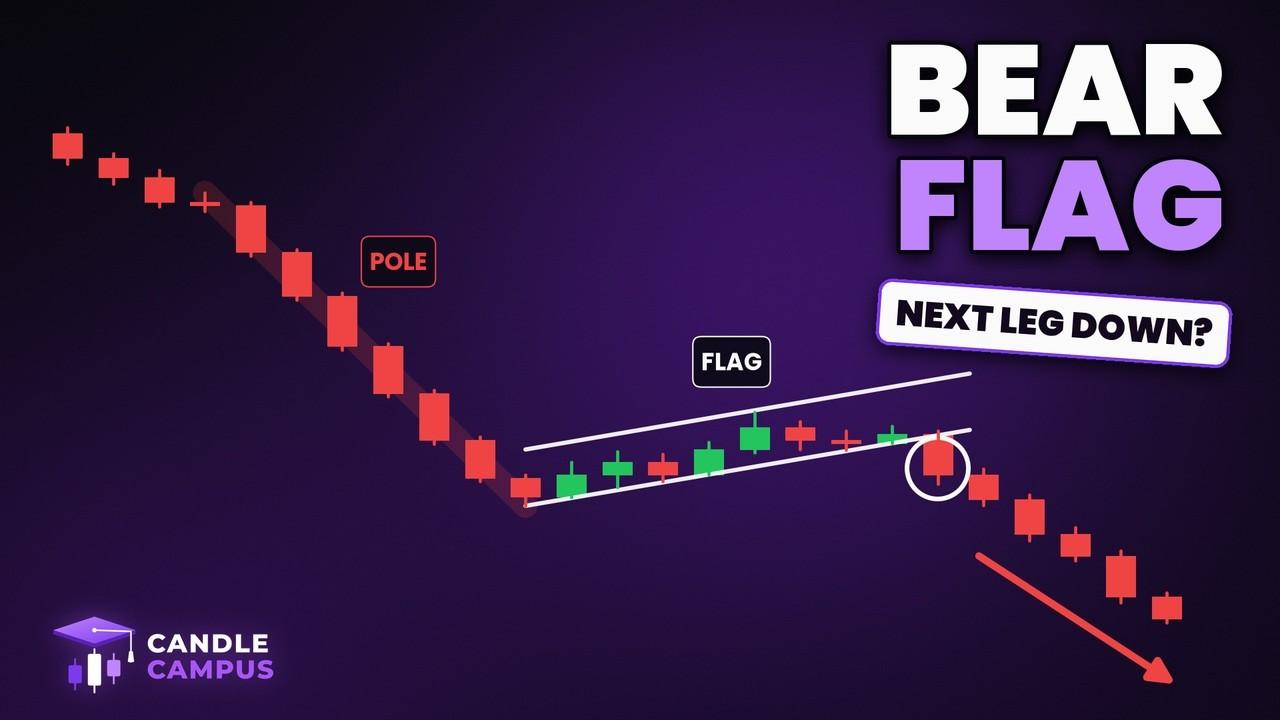
And the bear flag? It's just the mirror image: a sharp drop, a small pause that drifts up, then a close below the flag.
Common mistakes
- Calling every pullback a flag. Without a strong pole first, it's just a pullback.
- Buying inside the flag because you're scared of missing out, before anything is confirmed.
- A stop that's too tight, inside the flag, where normal wiggles can knock you out.
- Expecting the full measured move every time. Some breakouts stall early, and that's normal.
Quick recap
- Flagpole: a strong, fast move up.
- Flag: a short, shallow pullback between two roughly parallel lines.
- Confirmation: a candle closes above the flag's upper line, ideally with volume picking up.
- Plan: enter on that close, stop below the flag low, target the pole height added to the breakout.
- Risk: any flag can fail, so size your position so being wrong is just a small, boring loss.
This is education, not financial advice. Practice on charts before you risk real money.
Follow Candle Campus at @candlecampus for more chart lessons.